
TENNESSEE ERNIE FORD
Television watchers in the '50s and '60s (and who wasn't?) are well aware Tennessee Ernie Ford was quite a character. Music fans and radio listeners knew he had a serious side too. He hadn't figured on becoming a household name, but other people recognized his potential at a young age and he just followed where fate took him. An amiable personality with a down-home sense of humor and a rich baritone voice that suited him well as a radio announcer and singer, Ernie eventually built a multi-faceted career encompassing radio and television hosting including a top-rated NBC-TV variety series, country and pop singles and a top-selling string of gospel albums...all of these achievements at odds with a less-than-ideal family life.
Raised in a religious and musical family in Bristol, Tennessee, after graduation from high school in 1937 he applied for a radio announcer job at local station WOPI-AM 1500 and was hired on the spot for a wage of 25 cents an hour! A couple of years later he attended the Cincinnati Conservatory of Music to study voice training and singing. After taking radio jobs at WATL 1400 in Atlanta and WROL 620 in Knoxville using his given name Ernest J. Ford (sometimes without the middle initial), he joined the Army Air Corps in early 1942 as the United States entered World War II. With a rank of first lieutenant, he was stationed at George Air Force Base in Victorville, California, where he met Betty Heminger and married her later that year.
After his discharge in 1945, Ernie and his wife moved to nearby San Bernardino, where he'd secured a job at KFXM-AM 1240 when its format was country and western. Ernie wasn't even shooting for a singing career; he was fine with his radio announcing jobs. There were two sides to his daily show: for 30 minutes he took on the personality of "Tennessee Ernie," a hillbilly character running the "Bar Nothing Ranch," doing comedy bits that gained a rapid following. The rest of the time he was Ernest Ford, playing the hits and reading the news. Loyal King, the owner of KXLA 1110 in Pasadena, a 50,000 watt Southern California powerhouse, heard Ernie's show while driving through Bakersfield and loved what he heard. Ernie made the move to Pasadena, reaching his largest audience yet. In addition to his usual shenanigans, he would frequently open the mic while songs were playing and sing along. Ratings exploded. Soon Ernie was doing live shows under the title Hometown Jamboree with The Dinner Bell Roundup Club at the American Legion a little further south in Placentia (Orange County). For the first time, fans saw him in his "hillbilly" getup with oversize overalls and one tooth blacked out. Before long he was doing the show on Saturday nights at El Monte's American Legion Stadium and other L.A.-area venues.
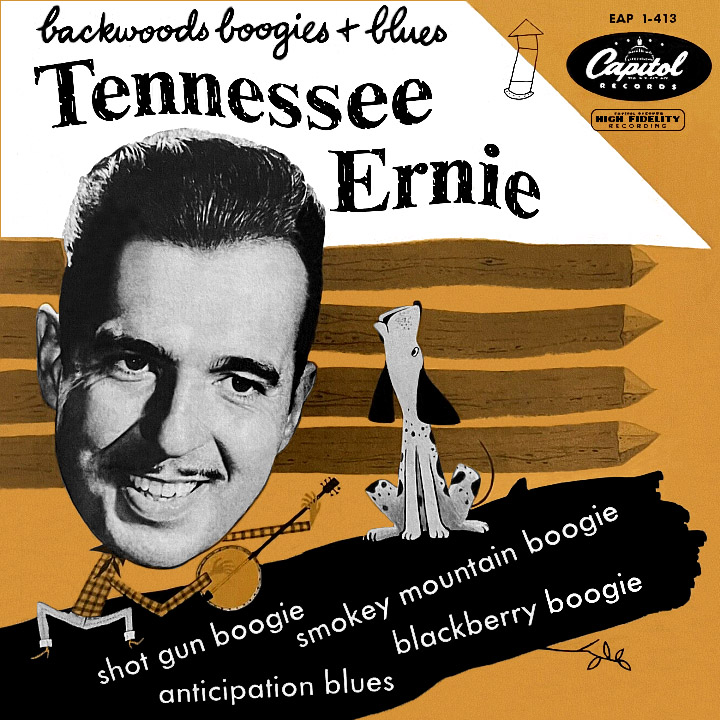
In 1949, Cliffie Stone (a fellow KXLA deejay and Capitol recording artist) introduced him to Lee Gillette, who headed up the country department at Capitol Records. Gillette had already heard Ernie clowning around on the radio and signed him with no hesitation. He began a series of "country boogie" hits recorded at Capitol's original Melrose Avenue studio (several years before the famous Capitol Tower near Hollywood and Vine was built). Most of the early Tennessee Ernie singles gave featured credit to either Cowboy Band or Western Band. An ace team of musicians played on these discs: guitarists Jimmy Bryant and Eddie Kirk, Speedy West on steel guitar, fiddler Harold Hensley, Stone on bass fiddle, the great Merle Travis on electric guitar and accordionist Billy Liebert (who doubled as arranger on many of the tracks).
"Tennessee Border," setting romance in a rural accordion-led arrangement was penned and originally recorded by fiddler Jimmy Work; despite Red Foley's better-selling version, Ernie had a top 20 C&W hit with his very first release. The songs followed a similar pattern: "Country Junction" and "Smokey Mountain Boogie," each a little more uptempo than the last, were successful, the latter being his first to reach the country top ten. Next came a two-sided hit: a cover of Frankie Laine's chart-topping pop smash "Mule Train," Ford's first pop hit, and its B side, "Anticipation Blues," with a yodel based on Hank Williams' style, a humorous recounting written by Ern about the stress surrounding his first child's birth,
Ernie debuted at the Grand Ole Opry in Nashville the first Saturday in 1950. He'd ditched the overalls, appearing in a more formal western attire. While his professional life was on the upswing, home life was on a downward path. His wife Betty had taken to drinking heavily (Ernie often had a little nip as well), which led to private and public outbursts, sometimes at music industy parties, often placing hubby in an awkward position. Ernie tackled the workload, continuing at KXLA over the next few years even as his music career was on a rapid rise. He dipped into the Frankie Laine catalog again in early '50, covering "The Cry of the Wild Goose" with a varied tempo, slow/fast arrangement and it did well in pop and country, reaching number two on the latter chart.
He joined Kay Starr on a top seller, "I'll Never Be Free," a number three hit in November. In early '51 he achieved his first C&W number one, "The Shot Gun Boogie," a perfect example of a backwoods honky-tonk jam. Ernie started performing in larger concert halls around 1951; one of the first was the Thunderbird Hotel in Las Vegas. His next top ten country hit was "Mr. and Mississippi," a cover of Patti Page's hit riverboat song that, like the earlier "Wild Goose," used a slow-to-fast tempo. Another Kay Starr collab paved the way for several duets with pop and country stars including Helen O'Connell, The Dinning Sisters, Ella Mae Morse and Molly Bee. In 1953, Ern went international, appearing at the London Palladium and setting the stage for long-lasting popularity in Great Britain.
A two-part appearance on CBS-TV's I Love Lucy was his first high-profile television appearance...on the number one-rated show. A good place to start! Broadcast a week apart in May 1954, the first episode has been described thus: "Ernie visited the Ricardos and wouldn't leave." The second week it was "Lucy and Desi finally got rid of him." In the summer of 1954, he had a short hitch as the host of NBC-TV's College of Musical Knowledge (originally a radio game show starring bandleader Kay Kyser, it had debuted in 1949). He began using his last name, keeping "Tennessee" in parentheses for a few years. Also that summer, he scored another hit with "River of No Return," the title tune (that he sang over the opening credits) for the film starring Marilyn Monroe and Robert Mitchum. Marilyn also hit with her version on RCA Victor. The previous year, Mitchum had co-written Ford's single "Hey, Mr. Cotton Picker.".
There was little free time in Ernie's life; his wife and two sons took second place to the hectic pace. If all the records and radio work weren't enough, he squeezed in more than 700 live shows all over the U.S. between 1949 and '55. And things were about to get more complicated: in January 1955, a daytime show starring Tennessee Ernie debuted. Jack Fascinato (previously with Kukla, Fran and Ollie) took the reins as his conductor, arranger and pianist. Soon, Jack joined him in the recording studio. "Cousin Ern" had a third guest shot on I Love Lucy ("the Ricardos run into Ernie while on a road trip!"), then helped popularize the coonskin cap craze with "The Ballad of Davy Crockett" from an episode of the recently-begun Disneyland series on ABC. Stage and TV star Bill Hayes made it to number one with his version in the spring of '55, but Ernie's and Fess Parker's discs weren't far behind. In the summertime, he released "His Hands," written by Stuart Hamblen, a religious song that anticipated the genre of music that would be his most popular...and lucrative.
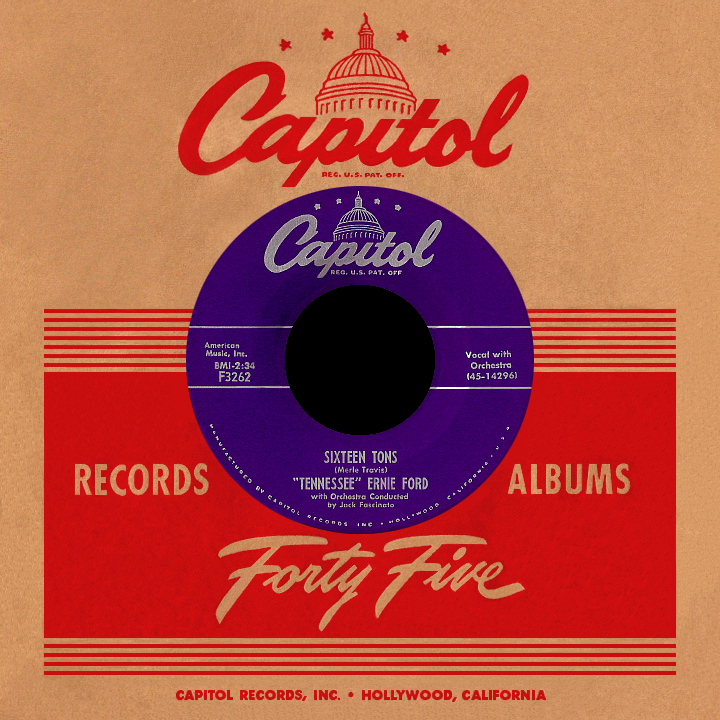
Before that happened, though, he scored one of the biggest hit singles of the entire decade. "Sixteen Tons" had been recorded in folkish style by its composer, Merle Travis, in 1946; Ford, a fan of the song, sang it at a concert appearance, where it received thunderous applause. He performed it on his TV show in a Fascinato arrangement three times the following month and decided he'd better make a recording of it: 'You load sixteen tons and what do you get?...another day older and deeper in debt...Saint Peter don't you call me, 'cause I can't go...I owe my soul to the company store...' The song has a catchy finger-snap done live by Ernie as he sang, to keep the rhythm; after hearing him practicing, producer Gillette insisted they release it that way and it became a big part of the song's appeal. The single debuted in the top ten the second week in November, hit number one before the end of the month and sold a million copies very quickly, going on to spend eight weeks at number one on the pop charts and rack up ten weeks at the C&W apex. It's been his signature song ever since. The flip side, "You Don't Heve to Be a Baby to Cry," penned by Bob Merrill and Terry Shand, was overshadowed by the A side but reached the charts; a version by country mainstay Ernest Tubb had been a hit in 1950.
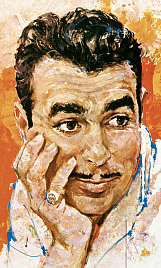
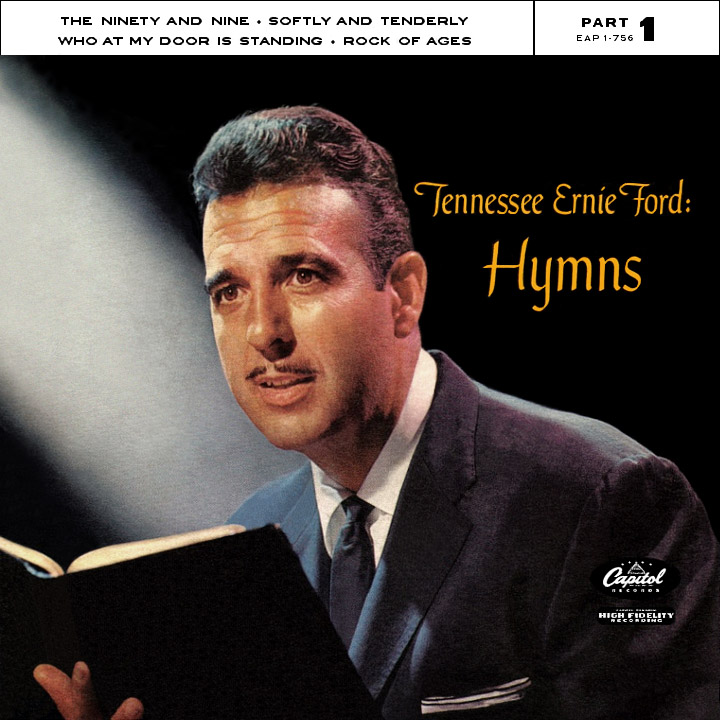
After a few modest hits in '56 including another Travis tune, "That's All," and the 1920s folk song "The Rovin' Gambler," he started The Ford Show, named not for himself but the sponsor, Ford Motors. The show ran for five seasons starting that fall and its consistently high ratings gave Ford automobiles a spike in sales, resulting in a huge raise that made Ernie one of TV's highest-paid hosts. Soon afterwards he made a decision that had NBC execs skeptical but turned out to be very popular: he began closing each show with a spiritual number. A full album was inevitable; Hymns hit stores in early 1957. Sales levels were on par with the decade's top albums, and it eventually topped the two million mark. More religious LPs followed...lots of them.
The singles issued in the late '50s (some of them amusing ditties like "Watermelon Song," "One Suit" and "Sunday Barbecue") paled in comparison to his albums (Spirituals, Nearer the Cross and Christmas offering The Star Carol all went gold), but personal challenges were becoming more of a priority. His wife, a full-blown alcoholic and pill-popper by that time, was frequently abusive to Ernie and the children (verbally and sometimes physically). Tiring of the overly time-consuming routine of his successful career, and seeking to spend more quality time with his family, he ended The Ford Show in the spring of 1961 after five seasons and slowed down the recording pace, sticking mainly with religious albums. The family moved to a ranch he'd bought in Clear Lake, California, about a hundred miles north of the bay area.
In April '62 he began a 30 minute daytime series on ABC with the straightforward title The Tennessee Ernie For Show, based in San Francisco, that lasted three years. He resumed making country records for Capitol ('60s style, a far cry from the boogie tunes of the '50s) and had a top ten country hit with "Hicktown," a spoken-and-sung novelty celebrating old-time, small-city living. The sacred LPs came like clockwork and he won a Grammy in 1965 for the album Great Gospel Songs (out of eight nominations total, all for his religious recordings). Ernie kept a profile on television, with occasional acting roles including a voiceover narration as the central character on the animated TV movie Mouse on the Mayflower, reunions with Lucille Ball on late '60s episodes of The Lucy Show and Here's Lucy and occasional guest appearances on variety shows like Rowan and Martin's Laugh-In and Hee Haw, followed by a string of low-charting country hits beginning in 1969 with "Honey-Eyed Girl (That's You That's You)" (penned by "Happy Whistler" Don Robertson) and ending with "I Been to Georgia on a Fast Train " (a Billy Jo Shaver song) in 1976.
Family life continued on a downhill spiral. His wife Betty made two suicide attempts, dying on the second try. Ernie stayed by her side through it all, to his own detriment. For awhile he made the routine work by golfing and hanging out with friends (many of them celebrities), but he was also hitting the bottle more and more as a way to cope. The one thing he continued doing was making albums - well into the 1980s - mostly consisting of spiritual material for the Word, Applause and Ranwood labels. Ultimately, he released more than 80 religious LPs in his lifetime. A second marriage in 1989 ended with his death two years later; he'd continued boozing, leading to eventual liver failure at age 72. His life had many highs and lows. Regardless, he's still well-remembered. "Tennessee" Ernie Ford entertained the public for many years.
NOTABLE SINGLES:
- Tennessee Border - 1949
by Tennessee Ernie with Cowboy Band - Country Junction - 1949
by Tennessee Ernie with Cowboy Band - Smokey Mountain Boogie - 1949
by Tennessee Ernie with Cowboy Band - Mule Train - 1949
by Tennessee Ernie with Western Band / - Anticipation Blues - 1949
by Tennessee Ernie with Western Band - The Cry of the Wild Goose - 1950
by Tennessee Ernie with Western Band - Ain't Nobody's Business But My Own - 1950
by Kay Starr and Tennessee Ernie / - I'll Never Be Free - 1950
by Kay Starr and Tennessee Ernie - The Shot Gun Boogie - 1951
as Tennessee Ernie - Tailor Made Woman - 1951
by Tennessee Ernie and Joe "Fingers" Carr - The Strange Little Girl - 1951
as Tennessee Ernie - Mr. and Mississippi - 1951
as Tennessee Ernie - You're My Sugar - 1951 /
by Kay Starr and Tennessee Ernie - Oceans of Tears - 1951
by Kay Starr and Tennessee Ernie - Hey, Good Lookin' - 1951
by Tennessee Ernie and Helen O'Connell - Christmas Dinner - 1951
as Tennessee Ernie - Rock City Boogie - 1952
by Tennessee Ernie and the Dinning Sisters - Hambone - 1952
by Tennessee Ernie with Bucky Tibbs - Blackberry Boogie - 1952
by Tennessee Ernie with Cliffie Stone's Orchestra - I'm Hog-Tied Over You - 1952
by Tennessee Ernie and Ella Mae Morse - Hey, Mr. Cotton Picker - 1953
as Tennessee Ernie - Don't Go Courtin' in a Hot Rod - 1953
by Tennessee Ernie and Molly Bee - The Honeymoon's Over - 1954
by Betty Hutton and "Tennessee" Ernie Ford / - This Must Be the Place - 1954
by "Tennessee" Ernie Ford and Betty Hutton - River of No Return - 1954
as "Tennessee" Ernie Ford - Ballad of Davy Crockett - 1955
as "Tennessee" Ernie Ford - His Hands - 1955
as "Tennessee" Ernie Ford - Sixteen Tons - 1955
as "Tennessee" Ernie Ford / - You Don't Heve to Be a Baby to Cry - 1955
as "Tennessee" Ernie Ford - That's All - 1956
as "Tennessee" Ernie Ford - The Rovin' Gambler - 1956
as "Tennessee" Ernie Ford - Rock, Roll, Boogie - 1956
as "Tennessee" Ernie Ford - First Born - 1956
as "Tennessee" Ernie Ford - Watermelon Song - 1957
as "Tennessee" Ernie Ford / - One Suit - 1957
as "Tennessee" Ernie Ford - In the Middle of an Island - 1957
- Bless Your Pea-Pickin' Heart - 1957
- Sunday Barbecue - 1958
- Glad Rags - 1959
- Hicktown - 1965
- Honey-Eyed Girl (That's You That's You) - 1969
- Happy Songs of Love - 1971
- Printers Alley Stars - 1973
- Farther Down the River (Where the Fishin's Good) - 1973
- Colorado Country Morning - 1973
- Come on Down - 1975
- Baby - 1975
with Andra Willis - The Devil Ain't a Lonely Woman's Friend - 1975
- I Been to Georgia on a Fast Train - 1976
- The Dogs and Sheriff John - 1976