
CHUCK JACKSON
By 1960, Passaic, New Jersey housewife Florence Greenberg had established Scepter Records in New York City with her first act, The Shirelles, who'd scored a top 40 hit, "Tonight's the Night," near the end of the year. Attempts were made at grooming a male act (group or solo) before Flo's company struck pay dirt. Chuck Jackson had by that time enjoyed a few years of minor, mostly-on-the-road success with a notable rhythm and blues group before he landed his first hit single with Scepter's new Wand Records imprint. Little did he know this small record label would offer him a chance to work with some of the industry's most highly-regarded professionals.
Winston-Salem, North Carolina was Charles Benjamin Jackson's birthplace in 1937, though he was brought up in Latta, South Carolina, a town with a population of little more than one thousand. His father left his mother when he was a baby and she moved to Pittsburgh a few years later, leaving him to be raised by his grandmother. He sang in church choir throughout childhood and at age six performed on a local radio broadcast. After a tour in the U.S. Navy he headed to Orangeburg, having been granted a music scholarship from South Carolina State College, though he cut his studies short, leaving to join Cleveland, Ohio-based gospel group The Raymond Rasberry Singers. Within a year an opportunity to join The Del Vikings was too good to pass up; at that time, in 1957, they had three hit singles but were in the process of splitting into two separate groups with slightly different spellings of the name. Though Chuck was a tenor, he was hired to sing baritone, taking the lead on the song "Willette," which was released near year's end on both the Fee Bee and Dot labels as a single credited to Kripp Johnson and Chuck Jackson.
The song was released again in 1959 under Charles Jackson with Kripp Johnson's Versatiles, then he made three discs for the Clock label, the first two as Charles Jackson, strong ballads like "Come on and Love Me," "I'm Yours," fast-paced rocker "Ooh Baby" and the string-drenched "Mr. Pride." Chuck met Jackie Wilson and opened for him at the Apollo Theater in Harlem; Jackie recommended he move around onstage...and when he fell to his knees during an emotional song, the audience responded enthusiastically. Offers came from RCA Victor and Wilson's label, Brunswick. Producer Luther Dixon, who happened to be Florence Greenberg's right-hand man, had seen Chuck at the Apollo and asked him to come to the label's office at 1650 Broadway where he signed with them, choosing the smaller operation over the major labels on a hunch they would work harder to promote him. He got more than he bargained for: some of the industry's hottest up-and-coming songwriters felt the same way about Flo and Luther and their passion for making records.
Around the time of Jackson's first session, Scepter issued "Don't Believe Him, Donna" by Texas-born singer Lenny Miles, who became the company's first hitmaking male singer (though his time in the spotlight was brief). Chuck's first effort came after a brainstorming session with Luther; he mentioned a girlfriend he'd broken up with then said, "I don't want to cry." A song, based on that idea, was released on Wand in January. Arranged by Carole King (just as she'd done with the Shirelles' "Will You Love Me Tomorrow," already fated to reach number one by the end of the month), "I Don't Want to Cry" turned out to be an exhilarating first hit for Chuck, reaching the top 40 in March while making a solid showing in the R&B top ten.
The second offering, "(It Never Happens) In Real Life" (penned by Dixon and Ollie Jones, an accomplished songwriter from Philly who'd composed hits for many stars including Nat "King" Cole), was a lighter-sounding pop tune with a downbeat theme, lamenting the difficulty of finding true love, that just missed the top 40. A Beltone reissue of the Clock single "Mr. Pride" simultaneously slipped into the lower rungs of the pop survey. Friends and associates of Flo and Luther regularly made contributions, producing or arranging; a soon-to-be celebrated pair, Burt Bacharach from Queens (who usually wrote the melodies) and Hal David from New York (who supplied the lyrics), composed the next single, "I Wake Up Crying," an unofficial (and more bleak) sequel to "I Don't Want to Cry." Many of Chuck's hits were recorded at Bell Sound Studios, this particular one featuring sisters Dionne and Dee Dee Warwick on backing vocals along with Myrna Smith (all of them members of The Gospelairs).
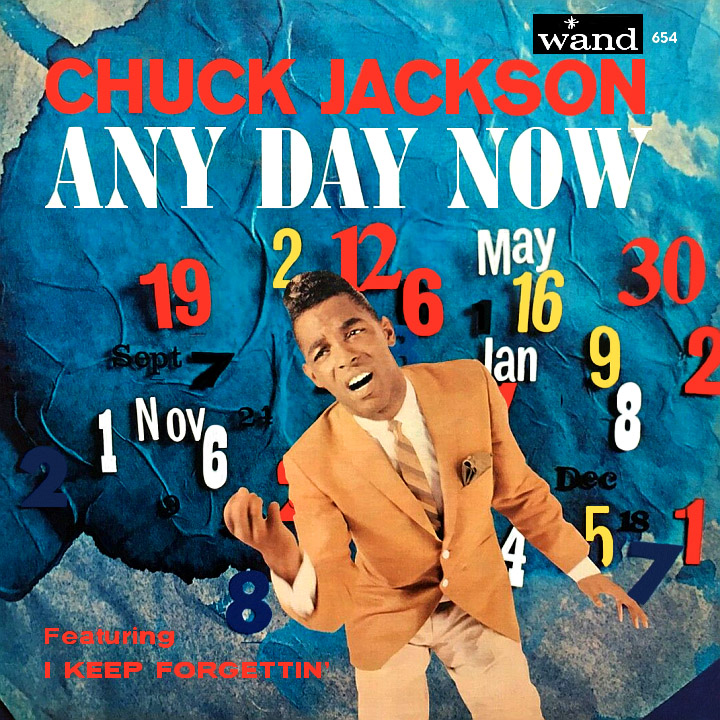
Bacharach came up with Jackson's biggest hit, though David didn't supply the lyrics. Bob Hilliard, a well-known tunesmith since the late '30s, was largely responsible for this gift to Wand's top solo act. The original track of "Any Day Now (My Wild Beautiful Bird)" was recorded with former Flamingos singer Tommy Hunt, but it was Jackson's reading of lyrics like '...you will have flown, oh...any day now, I'll be all alone...' that Dixon felt best conveyed devastating heartbreak. While it reached a respectable top 30 position, the song winged its way to number two on the R&B charts in June and July 1962 (held off the top spot by insurmountable competition: Ray Charles' "I Can't Stop Loving You," the year's biggest hit). A standard later recorded by dozens of singers, Chuck's original hit served as a crowd-pleaser for the rest of his life.
"I Keep Forgettin'" ('...you don't love me no more!') came later that summer, courtesy of Jerry Leiber, Mike Stoller and occasional collaborator (and former Cheers singer) Gilbert Garfield. With a creative percussion arrangement by stalwart N.Y. musical director Teacho Wiltshire, the song is one to remember forever, I ain't kiddin'. "Tell Him I'm Not Home" hit on a relatable problem...for any guy calling his so-called girlfriend on the phone. Doris Troy of "Just One Look" fame is the voice on the other end (Ike and Tina Turner flipped the script with "Tell Her I'm Not Home" a couple of years later). Chuck had developed a smoother style by this time, making him, more than ever, a favorite with the ladies on the nightclub circuit. In April 1964, he appeared on The Tonight Show, Johnny Carson's hot late night series in just its second year.
The next hit came from Rudy Clark in mid-'64: "Beg Me," about another breakup, found Chuck making demands should she want him back. Luther Dixon left Scepter/Wand around this time, leaving Jackson more frequently calling the shots. In the fall, "Since I Don't Have You," his soft, sensitive take on The Skyliners' late-'50s classic, found a new audience and airplay on more than a hundred stations coast to coast. Trying something different in '65, Florence teamed him with Scepter hitmaker Maxine Brown (who'd recently scored with the Gerry Goffin-Carole King gem "Oh No Not My Baby") on a duet version of Chris Kenner's "Something You Got" (an instrumental cover had recently lifted Ramsey Lewis's profile). The idea was a good one, the song reached the R&B top ten and a marriage-made-in-musical heaven was born.
For awhile the main focus was on the duets, though most of them languished in low-chart territory. The one other notable hit (out of seven attempts) was an early-'67 cover of Sam and Dave's smash "Hold on I'm Coming," the male-female dynamic giving the Isaac Hayes-David Porter composition a new flavor. At one point, Chuck did a solo remake of Maxine's "All in My Mind." But the lack of another big hit made him restless; his relationship with label owner Flo Greenberg became more strained. After one final single, "Shame on Me," he left the company that had been his home base for seven years.
He'd been good friends with Smokey Robinson since they'd crossed paths on the road several years earlier. On Smokey's recommendation, Berry Gordy signed Chuck to Motown. How could it go wrong? Well, for one thing, his work ethic didn't seem to fit with the way records were made at Motown. "(You Can't Let the Boy Overpower) The Man in You," an earlier Miracles song that Robinson had written, was his first single for the label. It barely showed up on the Hot 100 in early 1968. "Are You Lonely For Me," which had been a number one R&B hit for Freddie Scott two years earlier, made a little noise but fell off quickly. "Honey Come Back," a sad romantic song (Chuck's specialty) penned by Jim Webb a few years before, was the first released version in late 1969. It fared much better for Glen Campbell a few months later.
Gordy moved him to the V.I.P. label and gave him a little more freedom to work with other producers, like Hank Cosby on "Baby, I'll Get It" and Ivy Jo Hunter on "Let Somebody Love Me," but none of these caught on. He departed Motown in 1971. A single for Dakar in 1972 turned out to be a one-shot. Around this time another Charles "Chuck" Jackson emerged, from South Carolina, eight years younger, gaining fame as the lead singer of The Independents (their biggest hit: "Leaving Me" in 1973). With fellow member Marvin Yancy, he wrote songs for Jerry Butler and others. There was a little confusion, but the two Chucks managed to stay out of each others' way.
In 1973, Jackson recorded "I Only Get This Feeling" for ABC Records, reaching the Soul Singles (formerly Rhythm and Blues) top 40; "I Can't Break Away" made a lower showing that year. He had another another Soul hit on the All Platinum label in 1975, "I'm Needing You, Wanting You." He and Sylvia Robinson (known as the female half of Mickey and Sylvia in the '50s and as, simply, Sylvia in the '70s) duetted on "We Can't Hide it Anymore," a Vibration Records release in '77. In 1980 he was reunited with Luther Dixon; they worked together on some Bob Marley material, one of which reached the Soul chart: "I Wanna Give You Some Love." For another four decades, more or less, Chuck Jackson regularly toured and occasionally made records. He passed away in 2023 at the age of 85.
NOTABLE SINGLES:
- Willette - 1957
by Kripp Johnson and Chuck Jackson - Come on and Love Me - 1959
as Charles Jackson - I'm Yours - 1959
as Charles Jackson - Mr. Pride - 1960
- I Don't Want to Cry - 1961
- (It Never Happens) In Real Life - 1961
- Never Let Me Go - 1961
- I Wake Up Crying - 1961
- The Breaking Point - 1961
- What You Gonna Say Tomorrow - 1962
- Any Day Now (My Wild Beautiful Bird) - 1962
- I Keep Forgettin' - 1962
- Getting Ready for the Heartbreak - 1962
- Tell Him I'm Not Home - 1963
- Tears of Joy /
I Will Never Turn My Back on You - 1963 - Any Other Way - 1963
- Hand it Over - 1964
- Beg Me - 1964
- Somebody New - 1964
- Since I Don't Have You - 1964
- I Need You - 1965
- Something You Got - 1965
with Maxine Brown - If I Didn't Love You - 1965
- Can't Let You Out of My Sight - 1965
with Maxine Brown - I Need You So - 1965
with Maxine Brown - Good Things Come to Those Who Wait - 1965
- I'm Satisfied - 1966
with Maxine Brown - All in My Mind - 1966
- Hold on I'm Coming - 1967
with Maxine Brown - Daddy's Home - 1967
with Maxine Brown - Shame on Me - 1967
- (You Can't Let the Boy Overpower) The Man in You - 1968
- Are You Lonely For Me - 1969
- Honey Come Back - 1969
- Let Somebody Love Me - 1970
- I Only Get This Feeling - 1973
- I Can't Break Away - 1973
- I'm Needing You, Wanting You - 1975
- We Can't Hide it Anymore - 1977
by Sylvia and Chuck Jackson - I Wanna Give You Some Love - 1980