
JOHNNY NASH
The island of Jamaica gave birth to a unique style of music, identified by several names, that evolved over the course of the mid-20th century. Mento (inspired by African rhythms) was popular in the 1940s and '50s, ska (with more prominent bass and horns) came in the late '50s and '60s and was followed by rocksteady (slowed-down, bass-heavy grooves) later in the decade. These last two phases gained momentum in Great Britain and had limited crossover success in America with Millie Small's hit "My Boy Lollipop" and The Ska Kings' "Jamaica Ska," both in 1964, and Prince Buster's "Ten Commandments (From Man to Woman)" in '66, while many more originators were dominant on the Caribbean island. Ultimately, the musical style became more widely known as reggae, with its own recognizable beat, a cool, mellower version of what had come before. These early sounds were Jamaican through-and-through, until an outsider from Houston, Texas, a former teen idol named Johnny Nash, made a number of recordings - in a Jamaican studio - and played a large part, with the help of up-and-coming singer-songwriter (and eventual superstar) Bob Marley, in bringing the reggae experience to many other global regions.
While growing up in Houston's Fifth Ward, Johnny worked at Hermann Park Golf Course, singing each day while doing his job, impressing the players and landing an ongoing TV stint on Matinee, a weekday afternoon talk show on channel 2, KPRC. He was 13 at the time. Two years later, in 1955, he won a local talent show and was invited to perform in competition at the Apollo Theater in Harlem, New York, where he lost to dynamic star-in-the-making Joe Tex. Within a year he competed again, on CBS-TV's top-rated Arthur Godfrey's Talent Scouts, impressing Godfrey so much that he welcomed him back several times. A recording contract with ABC-Paramount resulted.
"A Teenager Sings the Blues," a smoky ballad, was Johnny's first release in the fall of 1956. A year later he scored with his third single, "A Very Special Love," his vocal style prompting comparisons to Johnny Mathis and no wonder: the song had been written by Robert Allen, a pianist on the Godfrey program with an impressive songwriting resumé that included Mathis ("It's Not For Me to Say," "Chances Are"), who'd coincidentally hit the scene at the same time as Nash. While Mathis became one of the decade's best-selling acts, Johnny Nash's ascent was much slower; he managed a couple of minor-charting singles in 1958 ("You're Looking at Me" and a cover of ""Almost in Your Arms," sung by Sam Cooke in the Cary Grant-Sophia Loren comedy Houseboat).
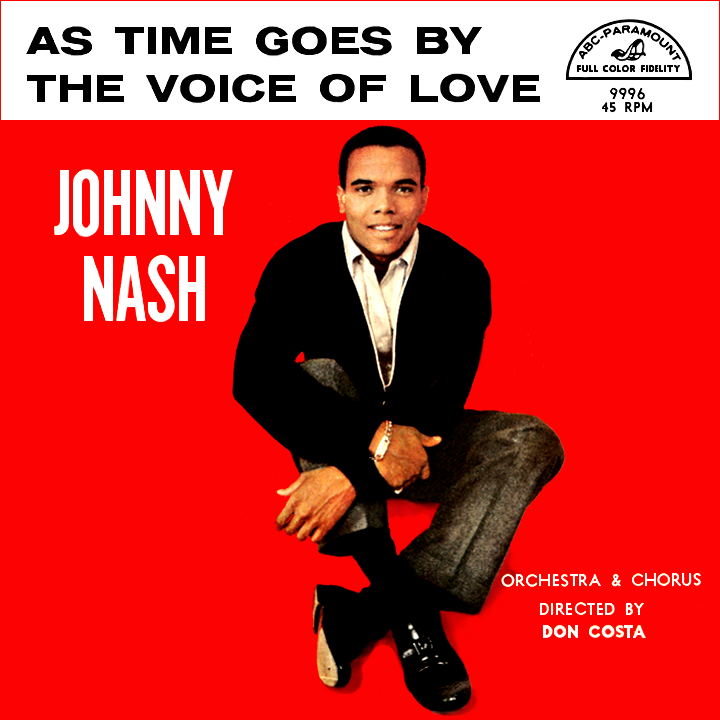
Johnny was handed an assignment: "The Teen Commandments," teaming him with young ABC-Paramount stars Paul Anka and George Hamilton IV, came to life as a short spoken-word track based the Bible's Decalogue, handed down from Hollywood's equivalent of Mount Sinai just months before by Charlton Heston (starring as Moses in the blockbuster film The Ten Commandments). These "new rules" for adolescents used some timely slang (line from Johnny: "Avoid following the crowd...be an engine, not a caboose"); the advice was cringe-worthy, though well-meaning, and the single reached the top 30 on the charts. Don Costa produced most of his early "teen crooner" efforts including "As Time Goes By" (the song by Jersey-born Herman Hupfeld that achieved classic status after Dooley Wilson performed it onscreen in Casablanca some 16 years earlier), a sizeable hit for Nash in the spring of '59.
Take a Giant Step, produced by Burt Lancaster and released that same year, kicked off Johnny's film career with a dramatic turn as a high school student affected by racism; during filming, he traveled with the film crew to Jamaica for location shooting, a fascinating experience that wouldn't soon be forgotten. He made another movie in 1960, playing a gang member in Key Witness. His contract with ABC-Paramount continued through the end of '61, during which time he recorded a song written by Phil Spector and Terry Phillips, "Some of Your Lovin'" (a spot-on imitation of Gene Chandler's vocal style). The time seemed ripe to put the whims of ABC A&R behind him and do things his way.
He signed with Warner Bros. Records, which provided no more leeway (he tried doing a Cooke kind of thing, but it didn't work out). He was, however, a favorite on the talk show circuit as a guest and performer on The Tonight Show (with both Jack Paar and Johnny Carson and the interim nights between the two host's eras). During a brief stay at Groove (an RCA Victor subsidiary), he was given more opportunities to be creative...and landed his first hit as a songwriter: "What Kind of Love is This," which reached the top 20 in 1962 by Joe Dee and the Starliters (a year later, he recorded his own version).
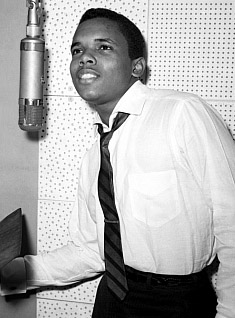
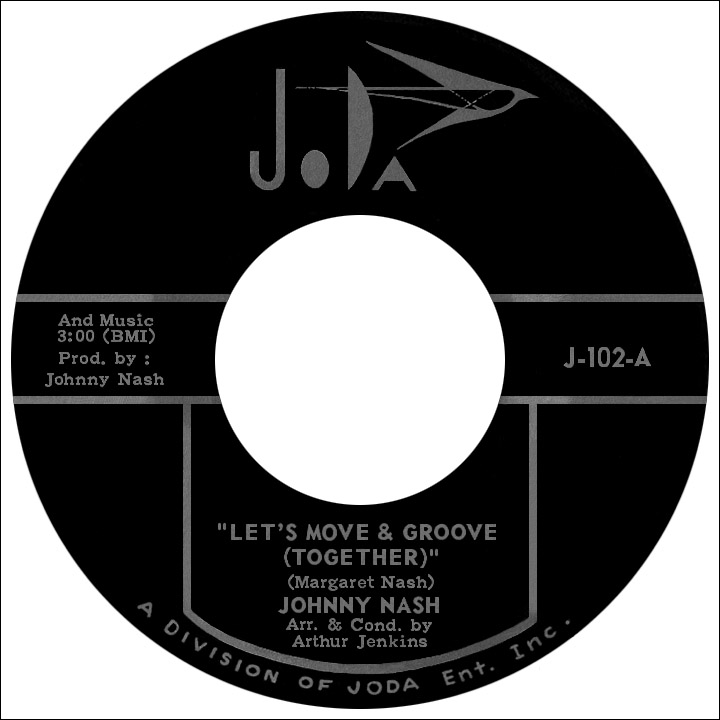
Around this time he met Mississippi native Danny Sims, who'd lived on the east coast for several years and became his manager. While putting in an uneventful year with the Argo label, Sims set Johnny up with gigs in several N.Y. supper clubs while he made additional income from the syndicated cartoon series The Mighty Hercules, for which he'd recorded the opening theme song. The two new partners started JoDa (their first names mashed together), a New York-based record label. In the fall of 1965, "Let's Move and Groove (Together)" was a top ten R&B (and minor pop) hit, with writer credit to Johnny's then-wife Margaret Nash (maiden name Rawlings), who'd done some modeling as Cissy Nash. The track served as Johnny's entrance into soul music, which he dabbled in afterwards. Sam and Bill, a soul act with a gospel feel, had two chart singles on JoDa in '65 ("For Your Love" and "Fly Me to the Moon"), both produced by Nash, while the label introduced The Cowsills, a foursome from Rhode Island, with "All I Really Wanta Be is Me."
Nash and Sims went to Jamaica and met writer and radio host Neville Willoughby, who introduced them to Bob Marley, a local favorite who'd had a breakthrough (in the islands, at least) with "Simmer Down," recorded with his group The Wailers (Bunny Livingstone and Peter Tosh) in late 1963 at Coxsone Dodd's Studio One in Kingston. Sims served as Marley's manager for several years afterwards. Back in the States, Johnny made more records for JoDa and, for about a year during late '66 and '67, MGM. A restructuring of the label took place as JoDa was changed to JAD (the name still stood for Johnny and Danny, much like Sam Cooke's former SAR label had been shorthand for Sam and business partner Rene Hall).
On a 1968 visit to Jamaica, Nash informed Marley and the Wailers he wanted to make records with the group, suggesting they could be stars in the U.S. Before going back, he recorded his own composition, "Hold Me Tight," with local musicians at Federal, one of the top studios in Kingston. It was produced by Nash and Arthur Jenkins, a third partner in the new JAD label, using a reggae arrangement ('...no more fussin' and-a fightin!'). A huge success in America and England, reaching the top five in both countries, it signaled a new direction for Nash as a performer (and 'I don't mean maybe...'). As promised, he put out a Wailers single on JAD, "Bend Down Low," credited to Bob, Rita and Peter (Rita being Alpharita Anderson, who had married Marley in 1966 and remained with him throughout his lifetime). A single, "Every Day Will Be Like a Holiday" by Byron Lee and the Dragonaires (alternately known as the Ska Kings), had been produced by Jenkins while in Jamaica and was issued on JAD. Neither Jamaican effort was successful, but that didn't affect the professional relationship and growing friendship between Bob and Johnny.
In 1969 he continued hitting the charts with "You Got Soul," done R&B style, and a remake of Cooke's "Cupid" with a pop/reggae beat, the latter returning him to the top 40. Both were top ten hits in the U.K. Also that year, he teamed with former Motown star Kim Weston for an unusual crossover single, "We Try Harder," which used the same phrase as Avis rental car commercials. In 1971, Johnny shut down JAD Records and went to Sweden for several months (with Danny and Bob tagging along) to star opposite actress Christina Schollin in a romantic drama, Vill så gärna tro (English title: Love is Not a Game, which isn't even close to the correct translation). Bob Bundrick, an acquaintance of Johnny's from Houston, collaborated with him, and Marley, on the film's music score, a departure from the rastaman's usual vibe. The experience motivated the two to continue writing songs together. Marley composed "Stir it Up" during this creative period and Nash's version, recorded in Jamaica with local musicians, was a U.K. hit (on CBS Records) in 1972.
Marley's contract was sold to Chris Blackwell of Island Records, giving his discs on the Tuff Gong label (established a few years earlier) a stronger promotional push; many top-selling hits followed for Bob and his Wailers. Johnny lived in London for awhile as "I Can See Clearly Now," another track from the latest Jamaican sessions, was issued on CBS while in the U.S. it appeared on affiliated label Epic. Its positive tone ('...I can see all obstacles in my way...gone are the dark clouds that had me blind...it's gonna be a bright, bright, sunshiny day...' ) connected with millions and spent four weeks at number one in November 1972, the highlight of his entire career in America and many other countries. "Stir it Up" belatedly reached the U.S. top 20 shortly after. Enjoying a higher profile for the next couple years, Nash appeared on TV (The Midnight Special, Soul Train) and continued turning out product for Epic/CBS.
In 1974 he bought a ranch in Houston and moved back home to lead a quieter life...which was interrupted a year later when his single, "Tears on My Pillow," reached number one in England. Several other minor hits took him through the decade. The final Johnny Nash album, Here Again, went the full reggae route and was released in 1986 on Britain's London label. He then made good on his "quieter life" plan, starting anew with wife number three, Carli Joyce Collins. "I Can See Clearly Now" has remained a pop culture benchmark, with recordings by several dozen artists of all types. In 1993 it was recorded for the Disney film Cool Runnings in a version that reached the top 20 for another of Jamaica's all-time great reggae singers, Jimmy Cliff.
NOTABLE SINGLES:
- A Teenager Sings the Blues - 1956
- I'll Walk Alone - 1957
- A Very Special Love - 1957
- My Pledge to You - 1958
- Please Don't Go - 1958
- You're Looking at Me - 1958
- Almost in Your Arms - 1958
- The Teen Commandments - 1958
by Paul Anka, George Hamilton IV and Johnny Nash - Walk With Faith in Your Heart - 1959
- As Time Goes By - 1959
- Take a Giant Step - 1959
- Goodbye - 1960
- Never My Love - 1960
- Some of Your Lovin' - 1961
- I Need Someone to Stand By Me - 1961
- Don't Take Away Your Love - 1962
- Ol' Man River - 1962
- What Kind of Love is This - 1963
- I'm Leaving - 1964
- Love Ain't Nothin' - 1964
- Let's Move and Groove (Together) - 1965
- Get Myself Together - 1966
- Somewhere - 1966
- Amen - 1967
- Hold Me Tight - 1968
- You Got Soul - 1969
- Lovey Dovey - 1969
- We Try Harder - 1969
by Kim Weston and Johnny Nash - Love and Peace - 1969
- Cupid - 1969
- (What A) Groovey Feeling - 1970
- Stir it Up - 1972
- I Can See Clearly Now - 1972
- My Merry-Go-Round - 1973
- Ooh What a Feeling - 1973
- There Are More Questions Than Answers - 1973
- Loving You - 1973
- You Can't Go Halfway - 1974
- Tears on My Pillow - 1975
- Let's Be Friends - 1975
- What a Wonderful World - 1976
- Closer - 1979
- Rock Me Baby - 1985