
PRETTY PURDIE
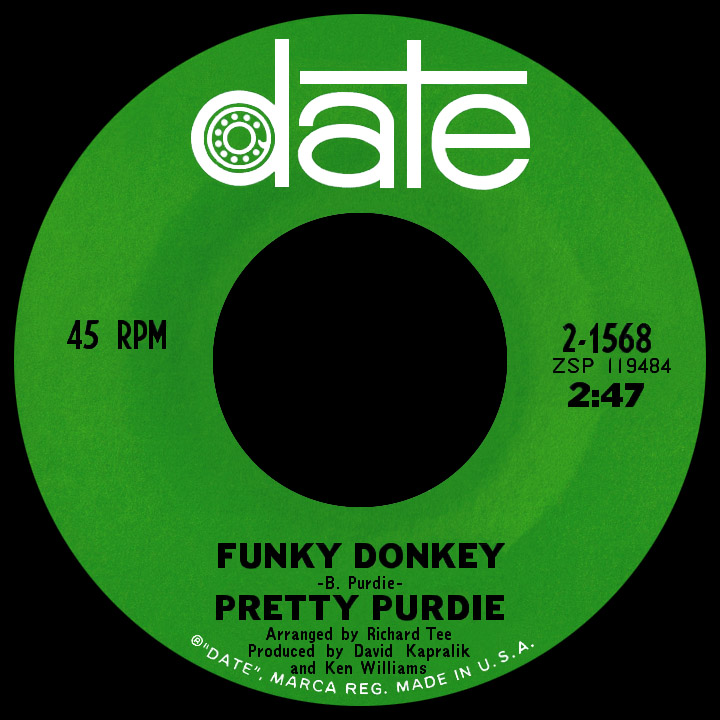
Funky Donkey
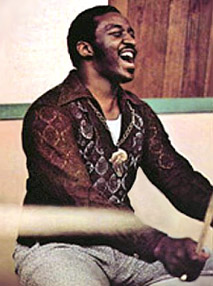
The best studio musicians tend to be meticulous about their craft, learning all sorts of tricks and techniques when it comes to recording music for physical records. One such example is drummer Bernard Lee Purdie, a timekeeping perfectionist with an ear for sonic clarity and dynamics. He's worked with the best and has made about two dozen albums of his own. Confident and naturally talented, he's well-known throughout much of the world as Pretty Purdie.
Growing up with 12 siblings, he would do just about anything to help support his family. At around age ten, in the late 1940s, he distributed flyers for local businesses in his home town, Elkton, Maryland (located on the northeast border of Delaware). Hiring several kids to post the single-sheet advertisements for 50 cents each per afternoon and keeping a close eye on them so they actually did the work, he would usually pocket ten dollars or more for himself. This entrepreneurial spirit and willingness to work hard served him well in the coming years. During his time at Elkton High School he took lessons from Leonard Heywood, a teacher and accomplished drummer who moonlighted with the Clive Bessex Orchestra. Heywood started Bernard on trumpet and flute (classroom "assignments" to give him a well-rounded familiarity with musical instruments) before allowing his percussive choice, instructing him on the acoustic aspects, basics of timing and how to set up the kit. Purdie's first public experience came as a pre-teen in the early '50s with Heywood's own band.
After high school, he received a scholarship to study business at Morgan State College in Baltimore, honing his skills as what you might call a future music hustler; during this time he sat in with some small bands in the area. In 1960, at age 20, he went with a few musican friends to New York, ending up at a Harlem nightclub where he met Sylvia Vanderpool of Mickey and Sylvia, which led to a studio gig backing the duo on a rerecorded version of their hit "Love is Strange," issued in 1962 on the Willow label. That led to more N.Y. recording dates, although he struggled for awhile, riding the bus to jobs and sometimes hauling his entire drum kit around. More work came and his skills are apparent on hits by Doris Troy, Les Cooper and King Curtis. He supplied the backbeat for some of saxophonist Buddy Lucas's records; later the script was flipped when Lucas played on Purdie's discs.
In an effort to get more work, he had colorful signs made (an unusual idea suggested by his friend, Jimmy Tyrell), placing them behind his drum kit while performing in public; phrases like "The Little Old Hit Maker" and "Bang Boom Pretty Purdie" made people in the music industry, who would often check out his shows, curious enough to hire him, so the ploy worked...and the Pretty Purdie moniker became a trademark. In the mid-'60s he struck up a friendship with Galt MacDermot (the songwriter who'd already won two Grammys for "Afican Waltz" by Cannonball Adderley), beginning a longstanding association. MacDermot was adamant about crediting session musicians in an album's notes and the practice gradually gained favor, resulting in Purdie and many others receiving long-overdue credit for their work.
In 1967, the "Pretty" one was hired to play on sessions for a new Date Records act, Peaches and Herb. Label heads were so impressed with his work ethic and skills that they offered him a recording contract (similar to other drummers-turned-hitmakers like Cozy Cole). Purdy wrote "Funky Donkey," inspired by the kinds of records James Brown had been recently making, but with an emphasis on percussion. The track, a hot groove with Purdie's drumming throughout, has a spoken intro by Buddy Lucas ("It's funky donkey time!...Do it to it!"), who also contributed tenor and baritone sax; the other players were Seldon Powell on sax, axeman Billy Butler (from Bill Doggett's trio), session guitarist Eric Gale, Bob Bushnell on bass and arranger Richard Tee on piano and Hammond organ. The single was a hit up and down the east coast; it reached Billboard's Hot 100 and the rhythm and blues top 50.
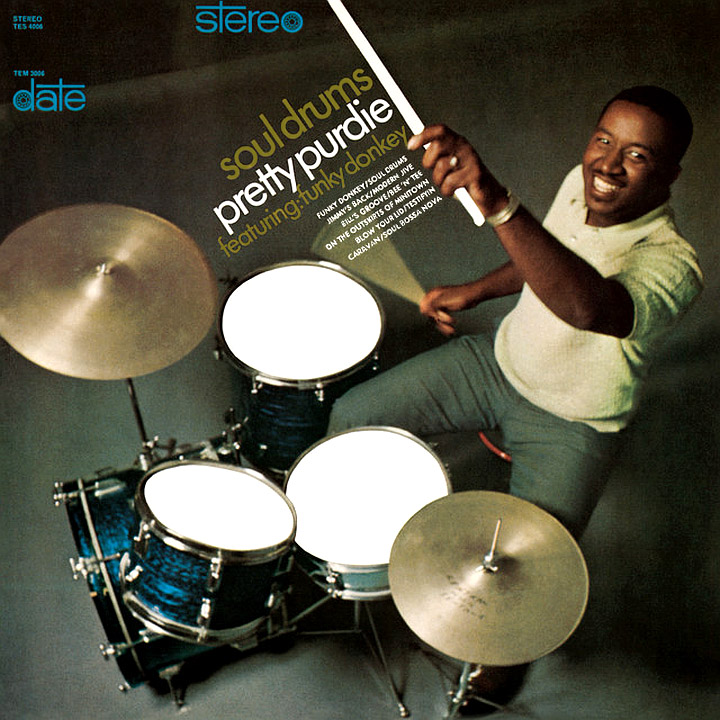
"Soul Drums," a brazen, wildly-paced workout (with more vocal shouts by Buddy and Bernard) became the title track of his Date album, its dynamic sound attributed mainly to engineer Phil Ramone, a favorite of Bernard's. His signature "Purdie Shuffle" had been developing with the use of eighth notes, 16th and 32nd notes, triplets and more, slowed down and structured within a two-bar phrase with Purdie's hi-hats, cymbals and other embellishments, a hard-to-play combination that became his signature style. The album was produced by Ken Williams and Dave Kapralik, though Purdie has claimed he did most of the work. A second single from the LP was "Modern Jive," more of an orchestral showcase with those ever-present drums. It reached the R&B top 50 in early 1968. A third single, "Soul Clappin'," was released in the spring. In 1969, he was moved to parent company Columbia for one single, "Fickle Finger of Fate," with label credit shown as Bernard "Pretty" Purdie.
His session work continued for nearly every top label, mostly in New York, occasionally in Los Angeles and other locations. Even a partial list of acts he backed is very long; a few of the big names whose records his drumming can be heard on include Herbie Mann, Nina Simone, Wilson Pickett, John Lee Hooker, Carla Thomas, Herbie Hancock and Dizzy Gillespie, as well as The Five Stairsteps' 1970 hit "O-o-h Child." He resumed making albums in 1971 with singer-songwriter Gil Scott-Heron and a new band he'd assembled called The Playboys; together they recorded "The Revolution Will Not Be Televised," a funky spoken-word political discourse centered around a phrase coined by Scott-Heron (with Purdie's beats prominent throughout). The recording was popular in New York City in the fall of 1971 and has gained notoriety in the years since, particularly with hiphop acts that came of age in the '70s and '80s.
Several strong, more jazz-leaning LPs (Purdie Good!, Soul is...Pretty Purdie) appeared in the '70s on the Prestige and Flying Dutchman labels, most of them produced by Bob Thiele, whose sensibilites were in line with the sometimes-outspoken drummer. The studio recording process, an experience he's never tired of, continued for decades. High-profile efforts included albums by Aretha Franklin, Roberta Flack and Donny Hathaway, Cat Stevens, Hall and Oates and Joe Cocker...plus, there were some stellar Steely Dan sessions. Later, jazz collabs with the likes of organists Jimmy McGriff and Jimmy Smith came at a steady clip. Having built a loyal following for his own work, he regularly released albums on a variety of labels into the early 21st century.
Artists have frequently sampled "Funky Donkey," "Soul Drums" and many of his other amazing recordings; a notable example is Beck's use of his beats on the 1996 album Odelay. Bernard Purdie's career has lasted more than 60 years, his personality vibrant and drum skills consistently sharp and precise. In interviews he's occasionally been asked if he thinks he could top all challengers for the title of "World's Greatest Drummer." One answer went something like this: "I will never be the greatest drummer...but I will be the prettiest!"