
LOU RAWLS
There's a good chance many people heard Lou Rawls for the first time without any idea who he was...on a radio hit he didn't receive credit for. Sam Cooke's classic two-sider "Bring it on Home to Me" and "Having a Party" both feature backing vocals from Lou that are obvious (once you realize it's him); the A side in particular could have been released as a duet. Lou and Sam had been friends since the late 1940s, having grown up on Chicago's South Side, so caught up in the vocal groups of the time that they often practiced singing harmony in the high school bathrooms for the echo effect.
Raised by his grandmother on Chicago's South Side, Lou sang in church choir and soon joined neighborhood gospel groups, starting with The Teenage Kings of Harmony, then The Holy Wonders and, in the early '50s, The Highway Q.C.s, named as such for many road tours that eventually took them from one coast to the other (Cooke and a very young Johnnie Taylor also put in time with the Q.C.s). Chicago had some of the country's most popular gospel acts and Lou was right in the midst of it. As adulthood approached and his baritone vocal cords developed, he attended shows at the Regal Theater near Washington Park, just a couple of blocks from the shores of Lake Michigan. Watching singers like Billy Eckstine, Arthur Prysock and Al Hibbler thrill audiences at the Regal gave him something to shoot for.
By early 1954, Lou had moved to Los Angeles and joined The Chosen Gospel Singers, whose "No Room at the Hotel" on the Specialty label was his first recording. Later in the year he became a member of The Pilgrim Travelers, a stint cut short when he joined the Army, serving in the 82nd Airborne Division from 1956 to '58. On returning, he resumed performing with the Travelers; he and Sam (who was with The Soul Stirrers, another gospel act on Specialty) were in an auto accident that killed the chauffeur; Cooke spent several weeks in the hospital and Rawls' injuries were even worse. Recovery took the better part of a year, after which he took a different career path, much like Sam had done (with great success) in secular music. Fine-tuning the style he'd admired by Eckstine and others, he started making appearances in small nightclubs.
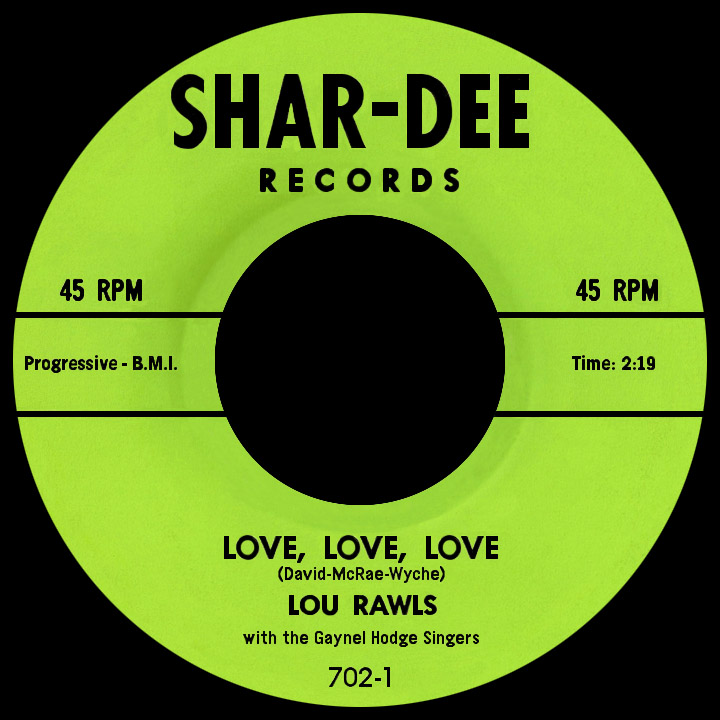
In the spring of 1959, Lou made his first solo record for the Shar-Dee label, a remake of The Clovers' three-year-old hit "Love, Love, Love" with backing vocals by The Gaynel Hodge Singers (Hodge was a Los Angeles-based singer-songwriter and pianist with extensive session experience who'd been a founding member of The Platters and co-writer of The Penguins' million sellier "Earth Angel"). Another single on Shar-Dee, the enjoyably mournful "Walkin' (For Miles)," was flipped with "Kiddio" (which predated the hit version by Brook Benton by several months); both sides were produced by Lou Adler and Herb Alpert, who frequently worked together in those days. "In My Little Black Book" and "80 Ways," separate releases for the small L.A.-based Candix label (where The Beach Boys got their start some months later) came in late '60 and early '61. These recordings were delivered in a rocking pop style that in retrospect seemed an odd choice considering Rawls' jazzy influences. But when Nick Venet of Capitol Records caught one of his shows, everything changed.
His earliest efforts for Capitol touched on different genres and arrangements, some folk, international pop songs and a swingin' recording of T-Bone Walker's late-'40s blues standard "Stormy Monday" with Les McCann Ltd. (the name of pianist McCann's jazz trio that included bassist Leroy Vinnegar and drummer Ron Jefferson). John D. Loudermilk's folk-style lament "Tobacco Road," a minor chart entry in the fall of '63, became the highlight of live performances when he added a spoken introduction that had clubgoers buzzing. Lou became a star on the nightclub circuit...but hadn't yet scored a mainstream hit.
"Three O'Clock in the Morning," a song written in 1919 by Argentinian Julián Robledo, an unlikely instrumental hit for Bert Kaempfert in the spring of 1965, is notable for being the first single by Rawls to reach the Billboard Hot 100; his vocal interpretation of New Yorker Dorothy Terriss's lyrics slipped into the lower rungs for one week, just as Kaempfert's disc was gently gliding in the top 40. By mid-'66 Lou had been with Capitol five years, uncertain as to just when their investment in his talents might expire. A version of Paul Francis Webster and Johnny Mandel's Oscar-winning "The Shadow of Your Smile" (from The Sandpiper, the latest in a double-digit spate of Liz Taylor-Richard Burton movies) marked the end of the mid-'60s easy listening phase of his career.
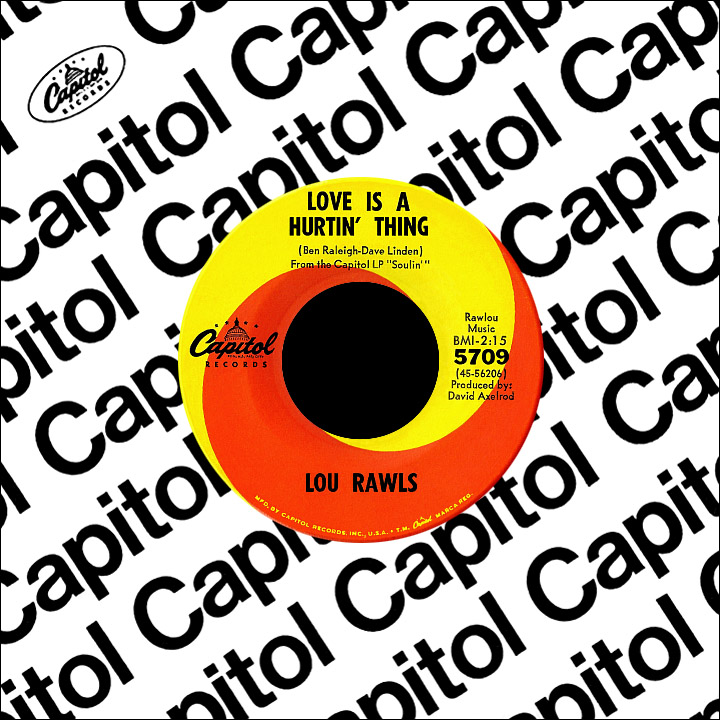
Capitol's A&R exec David Axelrod, who'd been working with Rawls for two years, encouraged him to move away from the jazz and pop direction. He produced "Love is a Hurtin' Thing," penned by Ben Raleigh and Dave Linden (a pair of songwriters themselves in need of a breakthrough), placing Lou squarely in the soul music canon; a top 20 hit for several weeks in October and November '66, it made its way to number one on the R&B charts. In early '67 he received a pair Grammy nominations for the song.
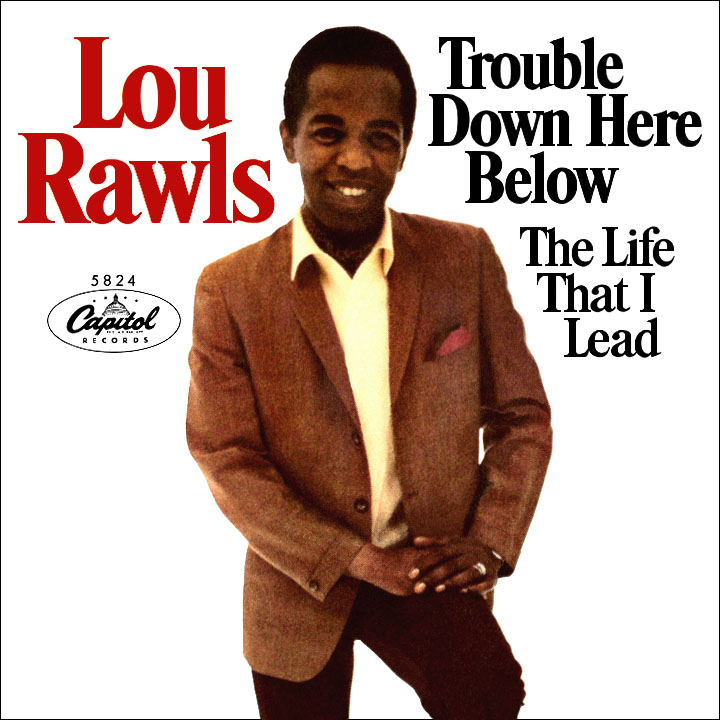
Axelrod continued working with Rawls, who turned out a sophisticated brand of soul with songs like "You Can Bring Me All Your Heartaches" and "Trouble Down Here Below," before scoring the next big one in the spring of '67, "Dead End Street," a gritty Axelod-Raleigh number with a spoken monologue by Lou (shorter than but similar to "Tobacco Road"), sharing some details of his Chicago youth ('...they call it the Windy City because of the hawk...almighty hawk, mister wind...') and a simple coming-of-age gameplan ('...soon as I was big enough to get a job and save enough money, get a ticket to catch anything, I split...'), shifting into high gear belting a line about '...a city without a heart.' It went top 30 pop, top ten R&B and NARAS showed appreciation for Lou's chops, giving him the award for Best Male Rhythm and Blues performance, one of the two categories he'd conceded to Ray Charles the previous year.
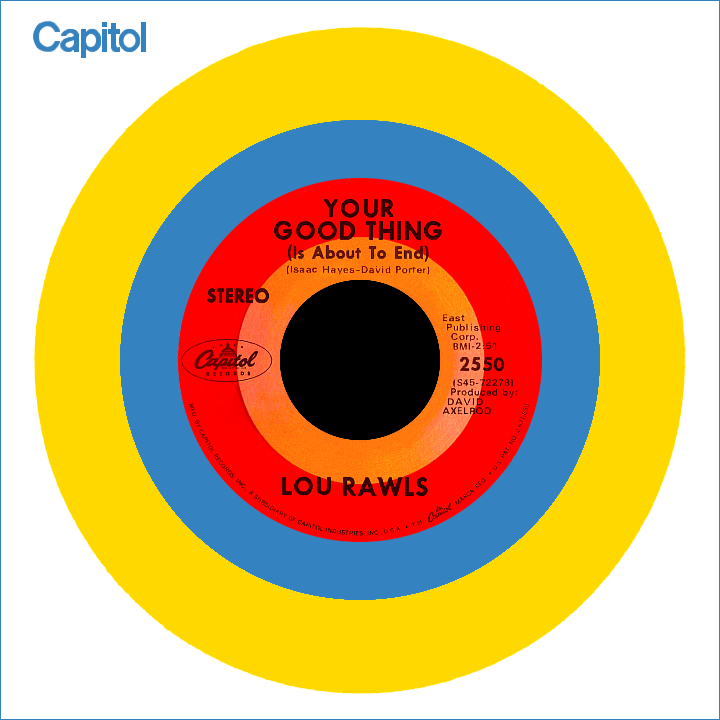
Other notable singles in '67 and '68 include his ode to "Show Business" (written by R&B singer June Jackson, a man despite the name!), "Little Drummer Boy" (one of the most popular of many versions of the Christmas standard best known by The Harry Simeone Chorale) and "Down Here on the Ground" (from Cool Hand Luke starring Paul Newman, it was composed by the unusual pairing of Lalo Schifrin and Gale Garnett). In the summer of 1969, "Your Good Thing (Is About to End)" (written by Isaac Hayes and David Porter and first recorded by Mabel John in '66) returned Lou to top 20 pop/top ten R&B territory while nabbing him a fourth Grammy nom.
"Bring it on Home," a funky, down-home, shorter-titled 1970 tribute to his '62 collab with Sam Cooke (who'd tragically passed six years earlier) was produced by Axelrod, who worked closely with Rawls through the end of his Capitol contract. Moving to MGM Records, he scored a big hit in 1971 with "A Natural Man" (penned by "Sunny" star Bobby Hebb and comedian-songwriter Sandy Baron), picking up a second Grammy win in the familiar Male R&B Performance category. A four-year drought followed, though he made many recordings for the MGM, Bell and Arista labels.
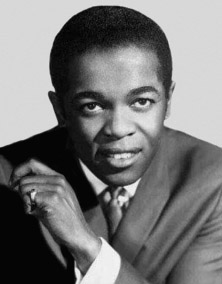
A rapid comeback commenced as soon as he signed with one of the 1970s' hottest record companies, Philadelphia International; "You'll Never Find Another Love Like Mine," penned by label owners Kenny Gamble and Leon Huff, was the biggest hit of his career, reaching number two on the Hot 100 while topping R&B and Easy Listening charts. Two Grammy nominations (one of them for follow-up hit "Groovy People") went up against Stevie Wonder's masterpiece Songs in the Key of Life, so losses in the categories came as no surprise. Around this time he became a commercial spokesperson for Anheuser-Busch; starting in 1980, the brand sponsored the annual Lou Rawls Parade of Stars telethon, which raised money for the United Negro College Fund and aired for many years.
Scoring again in 1977 with "Lady Love," he landed his third Grammy win in the usual category, but for an album this time, Unmistakably Lou. He was a NARAS favorite, winning four awards over the years, a level his longtime friend, the highly-regarded singer-songwriter Sam Cooke, oddly never came close to. His recorded output for Epic Records from 1982 to '86 included the original version of "Wind Beneath My Wings" (which Bette Midler took to number one after recording it for the 1989 movie Beaches). In the late 1980s, Rawls worked again with Gamble and Huff. He branched out with work on animated TV series during the 1990s and 2000s, supplying the singing voice of cartoon cat Garfield, then voicing Harvey the Mailman on Nickelodeon's Hey Arnold! and even a newborn baby on Rugrats, in addition to a live action role as nightclub owner Lou Raymond on Baywatch Nights.
There were problems later in his life: issues with relationships and domestic abuse claims led to lawsuits that took up a great deal of his time. Personal indiscretions notwithstanding, he was involved with a great deal of charity work and humanitarian endeavors. Hopefully certain aspects of Lou Rawls' personality don't take away from any longtime enjoyment of his expertly delivered baritone vocals on hundreds of recordings made during his 72-year lifetime.
NOTABLE SINGLES:
- Love, Love, Love - 1959
- Walkin' (For Miles) /
Kiddio - 1959 - In My Little Black Book - 1960
- 80 Ways - 1961
- That Lucky Old Sun - 1961
- Nine Pound Hammer - 1961
- The Bride (La Novia) - 1962
- Save Your Love for Me - 1962
- Stormy Monday - 1962
with Les McCann Ltd. - Tobacco Road - 1963
- Three O'Clock in the Morning - 1965
- The Shadow of Your Smile - 1966
- Love is a Hurtin' Thing - 1966
- You Can Bring Me All Your Heartaches - 1966
- Trouble Down Here Below - 1967
- Dead End Street Monologue/Dead End Street - 1967
- Show Business - 1967
- Little Drummer Boy - 1967
- My Ancestors - 1968
- You're Good For Me - 1968
- Down Here on the Ground - 1968
- The Split - 1968
- Your Good Thing (Is About to End) - 1969
- I Can't Make it Alone - 1969
- You've Made Me So Very Happy - 1970
- Bring it on Home - 1970
- A Natural Man - 1971
- His Song Shall Be Sung - 1972
- Walk on In - 1972
- She's Gone - 1974
- You'll Never Find Another Love Like Mine - 1976
- Groovy People - 1976
- See You When I Git There - 1977
- Lady Love - 1977
- One Life to Live - 1978
- Let Me Be Good to You - 1979
- Sit Down and Talk to Me - 1979
- I Go Crazy - 1980
- The Wind Beneath My Wings - 1983
- I Wish You Belonged to Me - 1988