
KAI WINDING
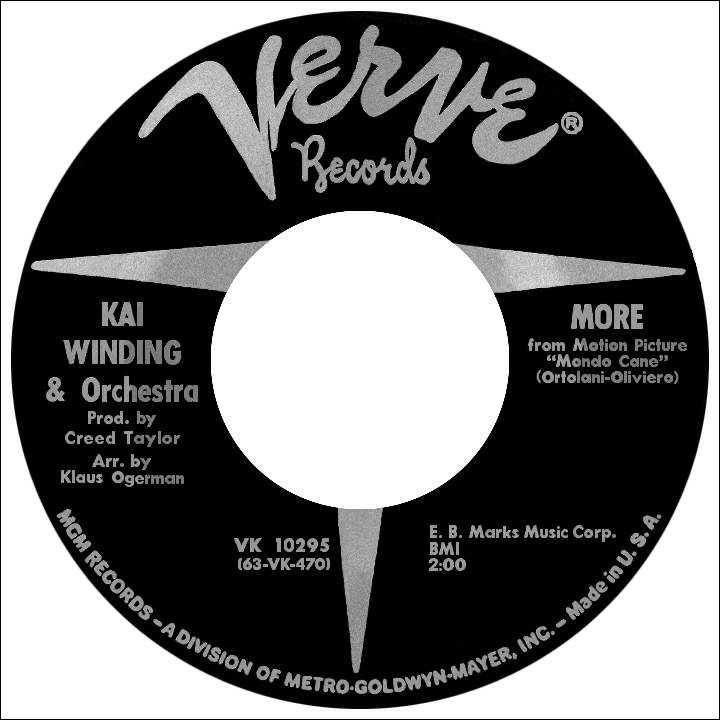
More
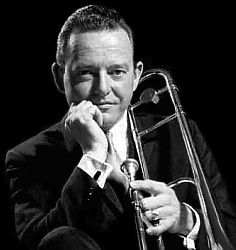
Danish jazz trombonist Kai Winding had musical inspiration coming from every direction. Finding himself on the ground floor of the be-bop movement, he was very much in demand as a sideman to many of the wildly improvisational musicians with whom he shared a common mindset, ultimately paving his own way as he gravitated towards creative diversion...for example, an unexpected dual-trombone partnership with J.J. Johnson in the '50s that served him well for several years. Changing pace in the '60s to a more mainstream series of albums and singles, he scored a major hit with "More," a melodic composition by Italian composers Riz Ortolani and Nino Olivieri that was featured in one of the most bizarre, notorious and dare I say controversial documentary films of the era.
His name was pronounced "ky win-ding" - pretty simple! - and he was born in 1922 in Aarhus (on Denmark's Jutland island, across from the smaller but more densely-populated Zealand, where the capital city of Copenhagen is located). Moving to the U.S. with his family in 1934, the 12-year-old took up the trombone and became quite proficient during his time at Stuyvesant High in New York's East Village. His technique evolved into something less conventional as a result of evading most formal instruction, so it came as no surprise that he was drawn to the sounds of Dizzy, "Bird," Miles and others when be-bop hit in the mid-1940s. He would eventually work with them all. A sideman for bandleaders Shorty Allen, Sonny Dunham and Alvino Rey in the early '40s, Kai then served with the Coast Guard during World War II, afterwards gaining a spot with Benny Goodman. His group recording of "Loaded" for Savoy records in 1945 as Kai's Krazy Kats featured future tenor sax star Stan Getz.
As trombonist for Stan Kenton's ambitious 1946 Artistry in Rhythm album and series of concerts, Winding reached new heights, leading to his involvement with Miles Davis's 1949 classic Birth of the Cool. In 1953, he joined trombonist J.J. Johnson for an unusual series of albums combining each artist's unique approach to the trombone. Their be-bop background and ongoing habit of trying new tricks led to a long series of recordings for Columbia, Bethlehem, Prestige and Savoy using the names Jay and Kai or J.J. and Kai or K. + J.J. or even their full names sometimes on more than a dozen LPs containing inspired trombone harmonics with titles like "It's Sand, Man," "Wind Bag" and "Gong Rock," many with piano accompaniment by the great Bill Evans. The duo built a loyal following and toured extensively.
Creed Taylor, a young but already accomplished producer, presided over some of Kai and J.J.'s best efforts and branched out on separate projects with Kai. A series of '50s albums found Winding fronting a four-trombone lineup, which led to a 1958 set on ABC-Paramount, The Axidentals, adding vocalists to the multiple-horn approach. Winding and Johnson doubled up on a regular basis over the course of a dozen LPs before taking a break; 1960's The Great Kai and J.J. on the Impulse! label was a peak. In '61, MGM hired Taylor to head up Verve Records and Winding was signed to a contract. Suddenly the trombone master was turning out a wide variety of projects on singles and albums that allowed him to retain his predilection for experimentation while the label sought increased record sales. A Latinesque effort, Kai Olé, was followed by Suspense Themes in Jazz (with a single release of Henry Mancini's un-suspense-like "Baby Elephant Walk") and Solo, a Winding opus in spite of its absence of Johnson (the cool collaborator listeners had grown accustomed to).
Soul Surfin' appeared in early 1963; timed to take advantage of the instrumental surf music craze, the album's focus quickly changed when a hit single burst forth. Ortolani and Olivieri's "More" was featured in the 1962 film Mondo Cane (pronounced "mahn-do cah-nee"), a documentary (at least that's what its creators, Gualtiero Jacopetti, Paolo Cavara and Franco Prosperi, called it) with an alternate title, A Dog's Life. This bizarre collection of short segments (which its producers hypothetically scoured the globe to find) was likely the first of its kind, with glib English-dubbed narration by Anthony La Penna (who'd built an extensive acting resumé in low budget cult films) a recompense for some of the uneasiness brought on by scenes many unsuspecting moviegoers found shocking (weird rituals, lurid behavior, cruelty to humans and animals, odd couplings and just plain ridiculousness).
The movie's North American release coincided with Winding's cover of the song, which featured guitarist Kenny Burrell (who was credited on the album), though the main instrument was an ondioline, a curious electronic tube keyboard (an early synthesizer of sorts) designed some two decades earlier by French-born musician and inventor Georges Jenny (played on the track by his associate, Jean Jacques Perrey...uncredited). The single reached the top ten in August and faced competition from a vocal version by Vic Dana (with lyrics by U.K. songwriter Norman Newell); Kai came out on top, the album's title was changed to !!!More!!!, and it trended upwards towards Verve's intended sales goal. At odds with the film's stark visuals, the song's lush sound and romantic lyrics were embraced by several awards groups. It became a Grammy winner for all three writers in the category Best Instrumental Theme and earned an Oscar nomination for Best Original Song (performed on the Academy Awards telecast by Ortolani's wife, Katyna Rainieri). While Winding's and Dana's hit versions no doubt helped fuel the recognition, as cover artists they were barred from the statue-grabbing festivities.
Follow-ups by Kai included "The Lonely One" and songwriter Jerry Ragovoy's "Time is on My Side" featuring The Gospelaires; versions in 1964 by Irma Thomas and especially The Rolling Stones have overshadowed Winding's original. Mondo Cane, meanwhile, did so well at the worldwide box office that a sequel, Mondo Cane No. 2, was rushed to theaters in early '64 with a theme by Oliviero similar to the previous one (released as a single by Winding, "Mondo Cane #2" made a brief Billboard "Bubbling Under" appearance that March). These "shockumentaries," as the variant has since been labeled, gave birth to a long, dubious, critically-disparaged-but profitable series of "mondo" films including Women of the World and Africa Addio by the film's originators as well as countless ripoffs by other bandwagon-jumpers, each upping the ante of grossness while begging the question "Is it real...or was it staged?"
Winding continued releasing albums and singles for Verve through 1967, taking turns at jazz, country and rock material, faring best, perhaps, with the four-trombone concept on his 1966 LP Dirty Dog. Creed Taylor left Verve and formed his own CTI label, making a deal with A&M Records for distribution. In 1968 and 1969, Kai reunited with J.J. Johnson for three albums on A&M, then spent another decade taking on various projects for small record labels while making infrequent live performances. One of his two sons, keyboardist Jai Winding, found his niche as a session player for many rock and pop acts of the '70s and '80s. Jai's famous father, gifted trombonist Kai Winding, sadly passed away at age 60, in 1983, as the result of a brain tumor. He lives on through a "mondo" quantity of quality recordings.